About me
Updated October 3, 2026
/ɐ.ˈbʱɪ.ʃēːk ˈd̪ēː.sai/
I am a board-eligible general surgeon. I trained at Rutgers Robert Wood Johnson in New Brunswick, New Jersey, where I served as chief resident and received the John H. Landor, MD, FACS Award for Excellence in Teaching. In August 2027, I will begin a fellowship in Advanced Minimally Invasive and Robotic Surgery at UC Davis Medical Center.
My clinical practice is currently focused on robotic-assisted minimally invasive surgery and emergency general surgery. After fellowship, I plan to develop a subspecialty practice in foregut and abdominal wall surgery.
My research centers on AI governance in surgery, autonomous surgical robotics, and other applications of machine learning in surgery.
I am a graduate of Boston University's seven-year BA/MD program, where I studied linguistics and medical science. Before that, I was a cadet firefighter and EMT at the Cabin John Park VFD in Bethesda, Maryland. I wrote about my path to surgery in Calm, Practiced Hands.
Besides medicine
What does "headclone" mean?
I have maintained a personal website since about 2006. My first, cybermonkey.com, was a place to host the Adobe Flash games my friends and I were making in computer class. When we began posting our games on Newgrounds and AddictingGames, I found the cybermonkey username had already been claimed on both sites.
Around the same time, I saw a talk Randall Munroe (the physicist behind xkcd) gave at Google, in which he described how he had chosen xkcd as his handle — basically, because it was meaningless. Earlier that week I had begun learning to write actual code, and one of my first programs was a random word generator built on dictionary.com. My first test of the program erroneously output two words as a conjoined string instead of one:
Hi! Your word of the day is: headclone.
I have used headclone as my handle across the internet ever since.
Dharma and yoga
Dharma (धर्म) and yoga (योग) are the central philosophical concepts of my life. I find great meaning in the idea of surgery as my form of karma yoga 1, and in this passage from the Bhagavad Gita 2:
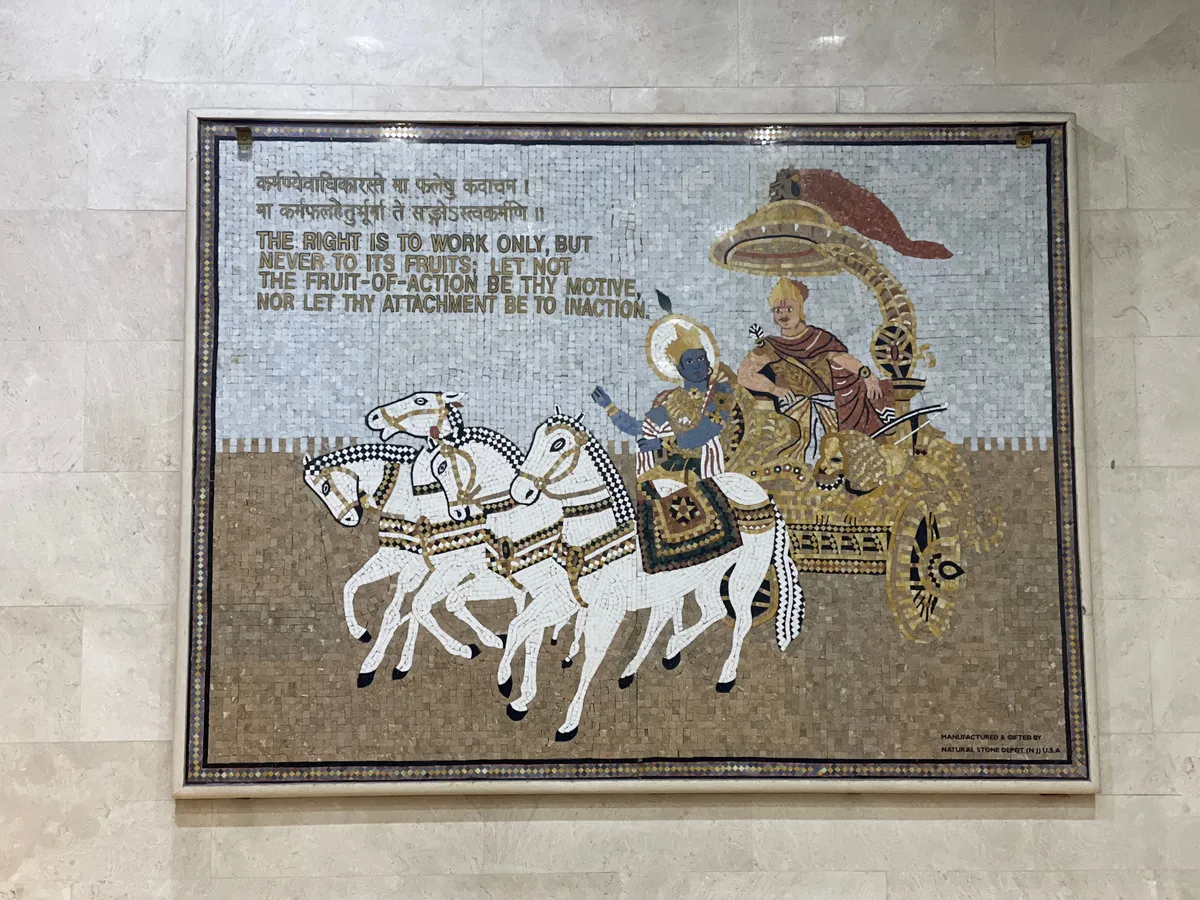
For years, my spiritual study centered on non-dual advaita vedanta 3. Through Hridaya's silent meditation retreats, I came to Kashmir Shaivism 4, and its tantric philosophy is now the focus of my study and practice.
Music
Music is a lifelong passion of mine. I grew up listening to my parents' Michael Jackson and Bollywood records and played saxophone and drumset through school. In college, I produced electronic music, joined a beatbox crew, and co-hosted a weekly radio show with friends called Future Funk Airlines; a few segments survive on SoundCloud, though most were removed due to copyright claims. In medical school, I played drumset in a jazz ensemble we called The Radial Groove, mostly covering Herbie Hancock and Stevie Wonder.
Nowadays, I am learning acoustic guitar (difficult to play saxophone or drumset while being a good apartment neighbor!) and mostly listen to jazz, electronic, and hip-hop.
Sport
I played baseball and basketball throughout my childhood. Team sports were a transformative experience for me as a kid, and Randy Pausch captures many of my own feelings about them in his beautiful last lecture at Carnegie Mellon.
In my teens, I earned a black belt in Tae Kwon Do and fought competitively for eight years, the last two as a junior striking instructor at our dojang. During college and medical school, I was an avid cyclist and rock climber, riding 50+ miles a week and progressing to V6 boulders and 5.11b free climbs over seven years.
Nowadays, my focus is on hatha yoga and bouldering.
Visit my now page for more.
Karma yoga (
कर्म योग), or the path of unselfish action, is one of the three classical spiritual paths (yogas) described in the Bhagavad Gita. Karma yoga is closely associated with the Hindu concept of seva (सेवा): the performance of selfless service without any expectation of reward.↩Told as a dialogue between a despondent man and God himself, the Bhagavad Gita synthesizes several millennia of Indian philosophy into an enduring summary of vedantic thought. It provides the most concise and accessible explanation of the foundational Vedic concepts of dharma (
धर्म) and karma (कर्म). I highly recommend Stephen Mitchell's translation.↩There is no greater introduction to advaita vedanta (
अद्वैत वेदान्त) than the compilation of Sri Nisargadatta Maharaj's lectures published in English as I Am That.↩Kashmir Shaivism is a family of non-dual Shaiva tantra (
तन्त्र) traditions that flourished in Kashmir from the ninth century onward, most famously in the work of Abhinavagupta and the Trika (त्रिक) school. Like advaita vedanta, it holds that the individual self and the absolute are one. Where advaita treats the world as māyā (माया), an appearance to see through, Kashmir Shaivism understands the world as a manifestation of consciousness itself (Śiva,शिव) through its own inseparable power (Śakti,शक्ति).↩